
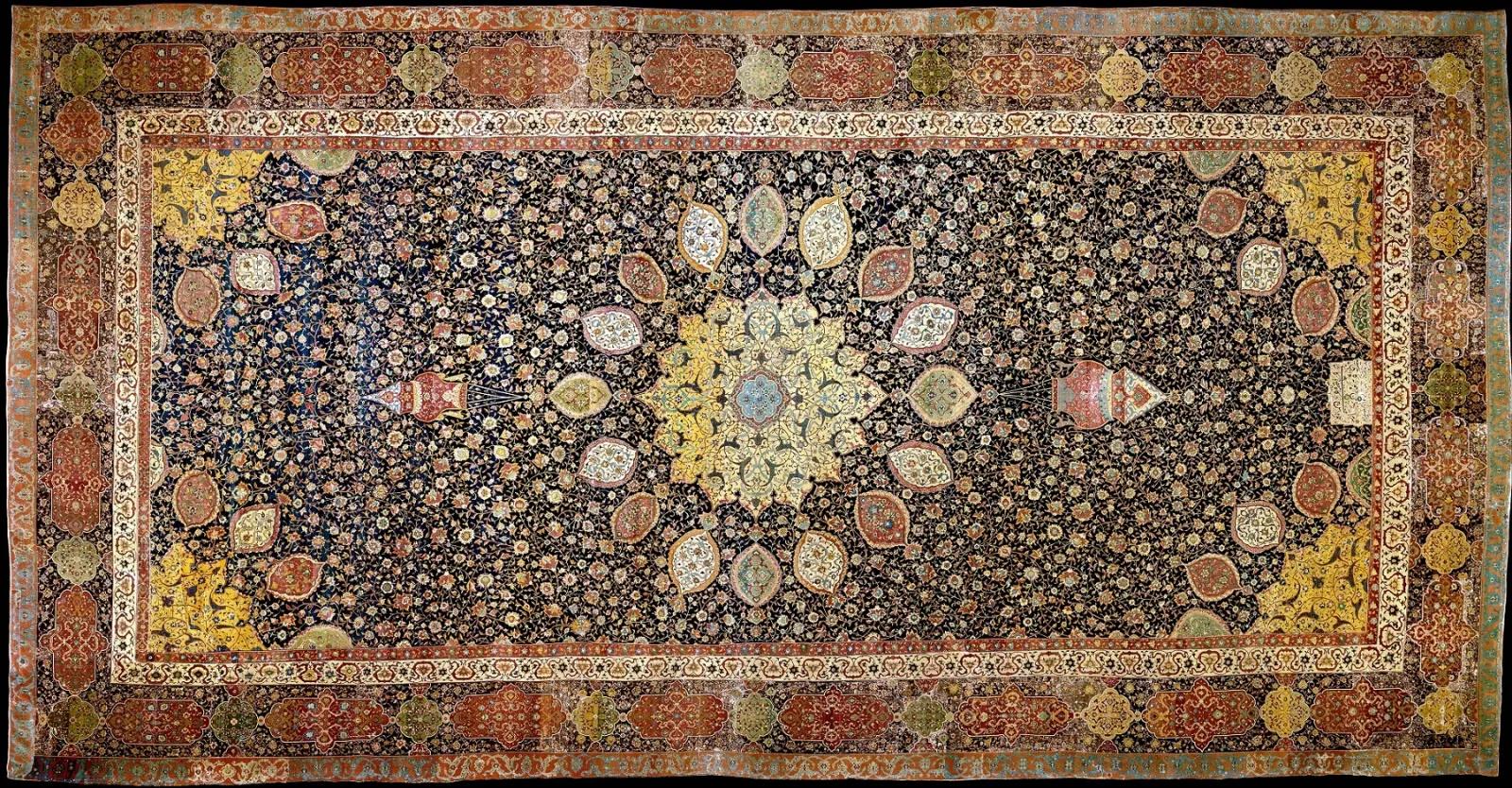
The Ardabil Carpet: From the Shrine of Sheikh Safi to the Victoria and Albert Museum
The Ardabil Carpet is not just a rug; it is one of the most celebrated and historically significant textiles in the world. Woven in the mid-16th century during the zenith of the Persian Safavid Empire, this masterpiece represents the perfect fusion of artistic brilliance, spiritual devotion, and royal patronage.
**A Royal Commission**
The carpet was commissioned by Shah Tahmasp I for the shrine of his ancestor, the revered Sufi saint Sheikh Safi al-Din, in Ardabil, Iran. This shrine was the spiritual heart of the Safavid dynasty, and the carpet was meant to reflect its glory and sanctity.
**Artistic Marvel**
The carpet is renowned for its breathtaking design. A central sunburst medallion is surrounded by intricate floral scrolls, lotus blossoms, and four corner pendants. Its harmonious color palette of deep reds, blues, ivories, and greens, derived from natural dyes, has retained its vibrancy for nearly five centuries. The precision of its Persian knots (asymmetrical) demonstrates unparalleled weaving skill.
**The Inscription That Tells a Story**
One of the carpet's most fascinating features is its poetic inscription, which includes a verse and crucial details:
*"I have no refuge in the world other than thy threshold. / There is no protection for my head other than this door."*
It ends with the signature, **"The work of the servant of the court, Maqsud Kashani"** and the date **946 in the Islamic calendar (1539-40 CE)**.
**A Journey Across Continents**
By the late 19th century, the shrine had fallen into disrepair, and its treasures were sold. The pair of Ardabil carpets were acquired by a British trading company. In 1893, the Victoria and Albert Museum in London purchased the better-preserved carpet. After a meticulous restoration, it became—and remains—a centerpiece of the museum's collection. The second, more damaged carpet was later fragmented; its sections are now held by the Los Angeles County Museum of Art and other institutions.
**More Than a Carpet**
The Ardabil Carpet is a symbol. It symbolizes:
* The **spiritual and political authority** of the Safavid rulers.
* The **pinnacle of Persian carpet weaving**, setting a standard for centuries.
* The **global journey of art**, from a sacred space in Iran to a world-renowned museum in London.
Today, visitors to the V&A can witness this monumental artwork, a timeless ambassador of Persian culture that continues to captivate and inspire audiences from around the globe.
Mohammad Eslami